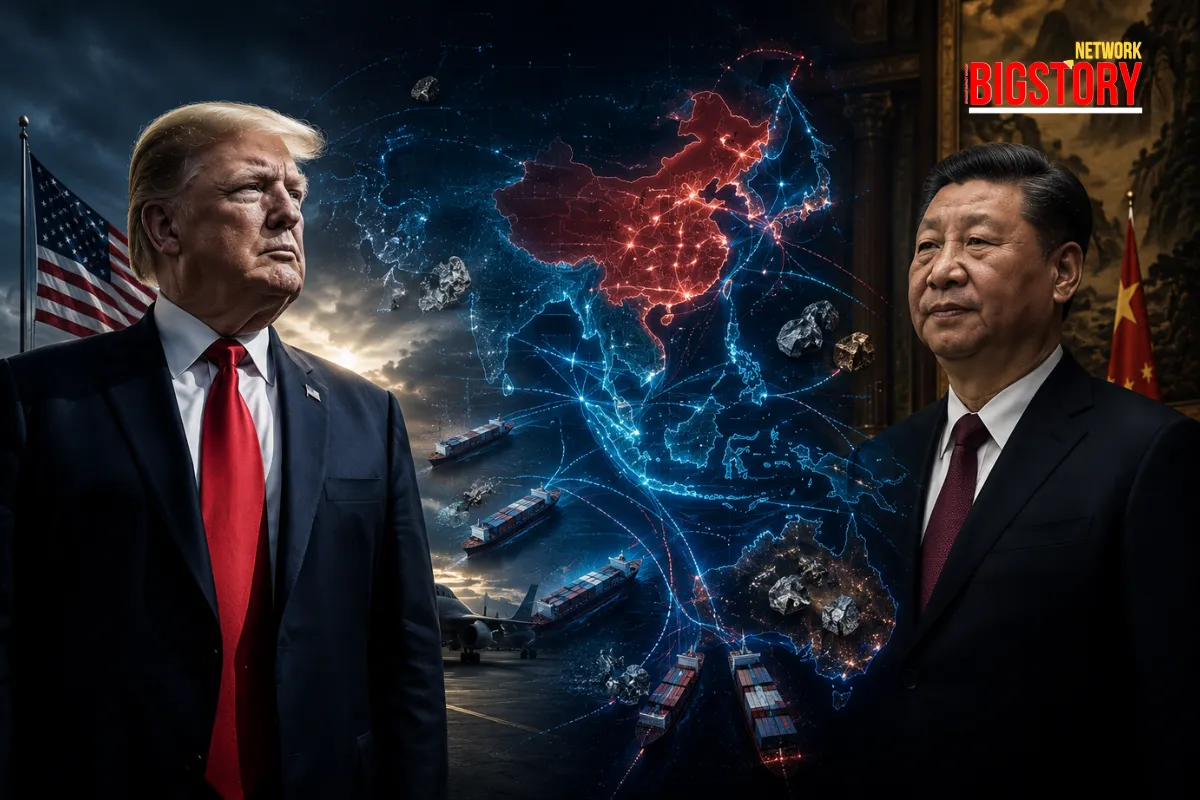
Washington demands diplomatic stability and massive agricultural purchases, but America’s intense military entanglement in the Middle East has handed Beijing the ultimate strategic leverage.
 Sseema Giill
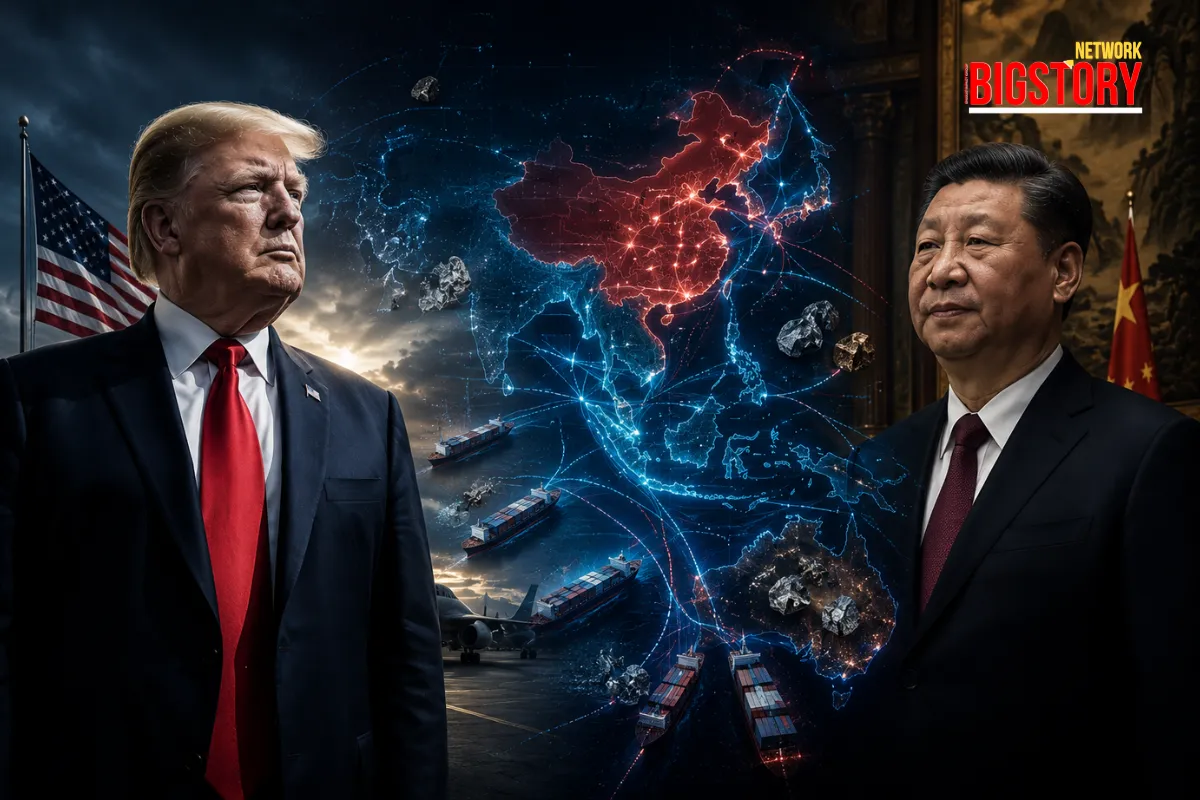
• What happened: US President Donald Trump arrived in Beijing on Wednesday evening, accompanied by top American business leaders, for a critical three-day bilateral summit with Chinese President Xi Jinping.
• Why it happened: The highly anticipated meeting, originally delayed by the sudden outbreak of the US-Iran war in March, aims to stabilize superpower relations amidst a strained global economy.
• The strategic play: Trump is pushing for major agricultural and aerospace purchases along with a "Board of Trade," while demanding Beijing use its influence to force Tehran into a final peace agreement. • India's stake: The summit's outcomes regarding semiconductor export controls, critical rare earth minerals, and Middle East stability will directly dictate the security trajectory of the entire Indo-Pacific region.
• The deciding question: Can Trump effectively enforce his trade demands when the US military is heavily relying on Chinese-controlled critical minerals to replenish the munitions it is burning through in the Middle East?
US-China relations entered a high-stakes recalibration today as President Donald Trump arrived in Beijing for a three-day state visit, setting the stage for a critical bilateral summit with Chinese President Xi Jinping. Touching down at Beijing Capital International Airport on Wednesday evening, Trump was greeted by Vice President Han Zheng and a military honor guard, marking his first return to Chinese soil since 2017.
The American delegation arrived heavily armed with corporate influence. Traveling alongside the President on Air Force One were tech and industry titans including Tesla CEO Elon Musk, Apple CEO Tim Cook, and Nvidia CEO Jensen Huang, along with family members Eric and Lara Trump. The White House is aggressively pursuing concrete economic deliverables rather than symbolic optics, prioritizing massive Chinese purchases of US agricultural goods and Boeing aircraft.
• The Trigger: The state visit formally commences after the White House significantly delayed the original March 2026 summit to manage the immediate outbreak of the US-Iran war.
• The Background: Trump is looking to establish a "Board of Trade" to manage future economic disputes, seeking to stabilize a global economy already battered by Middle East supply chain shocks.
• The Escalation: Washington is heavily pressuring Beijing—the world’s largest buyer of Iranian oil—to cut off Tehran's revenue and force a final peace agreement to end the Persian Gulf crisis.
• The Stakes: China continues to define Taiwan as its absolute "red line," with Xi Jinping expected to issue stark warnings against any further US arms sales to the island.
Donald Trump, President of the United States
Trump is demanding tangible economic victories to offset the rising domestic inflation caused by the protracted war in the Middle East. His primary objective is securing a managed trade framework while pushing China to economically suffocate Iran.
Xi Jinping, President of the People's Republic of China
Hosting the summit from a position of deep strategic patience, Xi is demanding immediate relief from aggressive US investment restrictions and export controls on advanced semiconductors, leveraging the presence of US tech CEOs to force the issue.
The Tech Delegation
The high-profile inclusion of Musk, Cook, and Huang highlights the absolute centrality of the Tech and AI battlefield. Their presence underscores the tension between Washington's desire for strict AI deconfliction channels and Silicon Valley's desperation for unhindered access to the Chinese market.
Mainstream coverage frames this summit as a classic clash of economic superpowers, but the real negotiating power relies entirely on the invisible shift in global leverage caused by the Middle East conflict. During Trump's first term, aggressive, unilateral tariffs served as Washington's primary weapon against Beijing. However, Trump is entering this 2026 summit with a fundamentally weakened hand.
The protracted US-Iran war is currently spiking American inflation and severely draining US military resources. Conversely, China has heavily insulated itself against short-term oil shocks and maintains a near-monopoly on critical rare earth minerals. These minerals are not just necessary for electric vehicles; they are absolutely vital for replacing the advanced US munitions currently being expended at a rapid rate in the Persian Gulf. Xi Jinping is walking into these talks knowing that America's intense military entanglement in the Middle East has inadvertently handed Beijing the ultimate strategic leverage at the negotiating table.
• Tech Supply Chains: Any US concessions regarding semiconductor export controls will directly accelerate China's technological and military modernization, altering the balance of power along the Line of Actual Control.
• The Iran Vector: If Trump successfully forces Xi to choke Iran's oil exports, India must prepare for immediate global price volatility and severe disruptions to its own energy security matrix.
• The Diplomatic Tightrope: New Delhi must aggressively capitalize on Washington's vulnerabilities by accelerating its own critical minerals partnerships with the US and Australia to counter Chinese dominance.
• Immediate Governance: US negotiators will attempt to compartmentalize the immediate necessity of securing Chinese cooperation on Middle East shipping routes from long-term tech containment policies.
• Structural Shift: The US military-industrial complex is actively realizing the peril of sustaining a multi-front containment strategy when its primary geopolitical rival controls its raw material supply lines.
• India-Specific Consequence: A stabilized US-China trade pact could lead to the dumping of excess Chinese manufacturing capacity into South Asian markets, threatening India's "Make in India" initiatives.
If the Pentagon relies on Chinese rare earths to build the weapons it needs to fight in the Middle East, exactly how much leverage does the US President actually possess as he sits across from Xi Jinping?
• Channel News Asia (CNA): China announces Trump's visit from May 13 to 15
• The Soufan Center: Xi and Trump Scheduled to Meet with Several High-Profile Issues on the Docket
• Ministry of Foreign Affairs, PRC: U.S. President Donald J. Trump to Pay a State Visit to China
• DD News On Air: US President Donald Trump Begins Three-Day Visit to China
 Exclusive Content





Sign up for the Daily newsletter to get your biggest stories, handpicked for you each day.



 Trending Now! in last 24hrs